
Shore deep excavations and protect what's next door.
Earth Support
We offer customized earth retention systems including soldier piles, sheet piles, lagging and tiebacks to provide secure excavation support.
Cross-section
Callouts
Select a numbered part below to read what it is and what it does.
- A driven steel wide-flange pile installed at 6–10 ft on center; it carries the lateral earth pressure as a vertical beam spanning between tieback supports.
- Boards placed behind the pile flanges as the cut advances, retaining the soil between piles in each excavation lift.
- The sheathed length of tendon that transfers no load to the soil; it must extend past the theoretical failure surface so the anchor develops capacity in stable ground.
- The grouted zone — typically 15–40 ft — where the tieback transfers its tension load into competent soil or rock.
- The pile is driven below subgrade into glacial till or bedrock to develop passive resistance and control wall toe kick-out.
As-built sequence
From driven pile to a stressed, anchored wall
Drive the soldier piles, excavate in lifts, lag between the flanges, then drill and stress the tieback into competent ground. The cutaway draws the wall in that order and tensions the anchor into rock.
Typical spec
Plain-language view of the same typical ranges.
- How deep the wall goes
- 15–60 ft
- Roughly how far down the shoring holds back soil.Retained height drives wall stiffness & embedment; toe penetration sized for passive resistance.
- Spacing between vertical beams
- 6–10 ft o.c.
- How far apart the steel piles sit along the wall.Pile center-to-center sets lagging span & wall bending; refined to soil arching and surcharge.
- What the piles are made of
- W-shapes / sheet piles
- The steel shapes used for the vertical members.W-shapes / sheet piles selected for section modulus and drivability per the loading.
- Angle of the anchors
- 15–30°
- How steeply the tieback anchors are drilled.Inclination sets the vertical load component and routes the bond zone below the failure wedge.
How it goes in
- 01
Drive the piles
Soldier piles or sheet piles are installed along the excavation line to establish the support of excavation.
- 02
Excavate in lifts
Soil is removed in controlled lifts as the wall is built down, never getting ahead of the support.
- 03
Install lagging
Timber or other lagging spans between soldier piles to retain soil between the flanges.
- 04
Drill & stress tiebacks
Tieback anchors are drilled, grouted, and stressed to lock off the wall against lateral earth pressure.
Equipment on this work
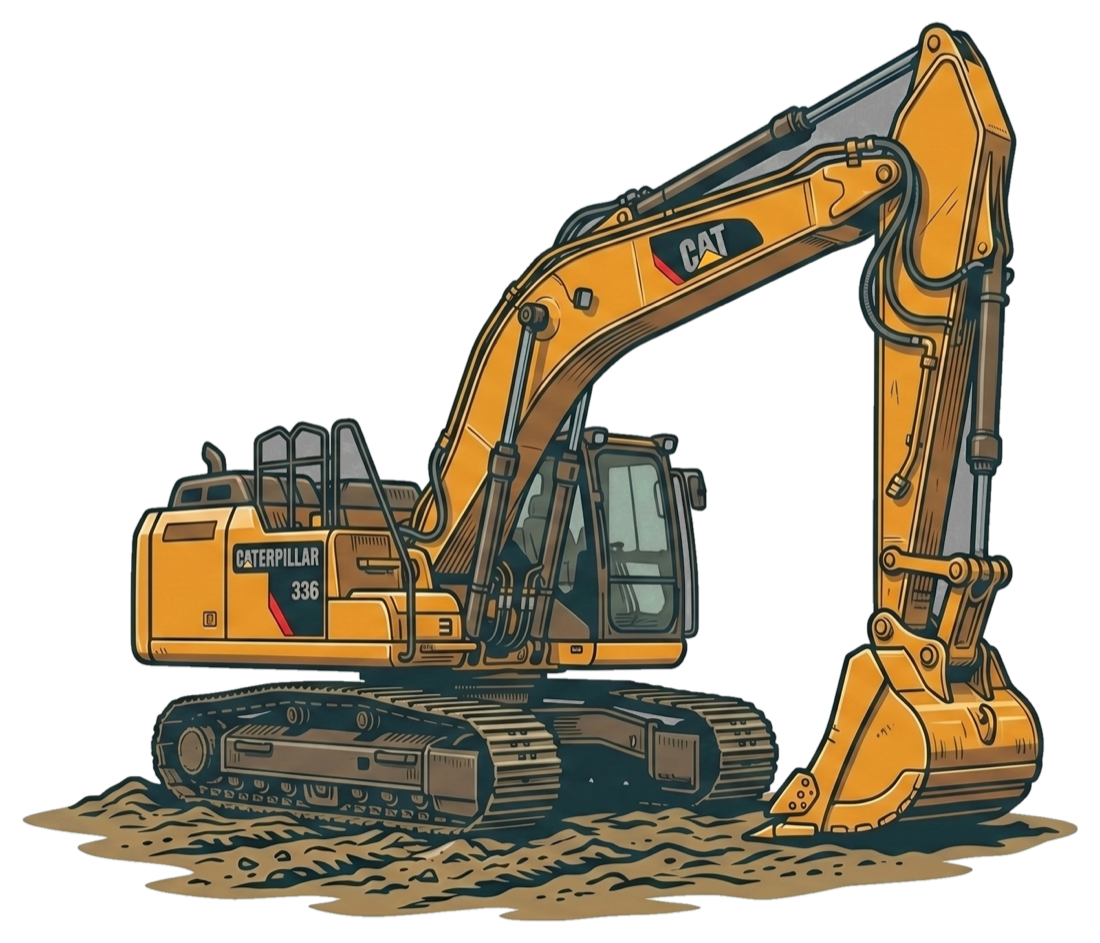
Caterpillar 336
Tracked hydraulic excavator
Equipment shown as illustrative renderings.
Where it fits
- Deep basement and below-grade excavations
- Excavations tight against adjacent buildings
- Slope and embankment retention
- Utility and infrastructure cuts
Frequently asked
Related projects
Illustrative tear sheets — example case studies pending verification.
Ready to scope your foundation?
Tell us about the project and we'll put together a detailed quote within 3 days. We generally work with general contractors.